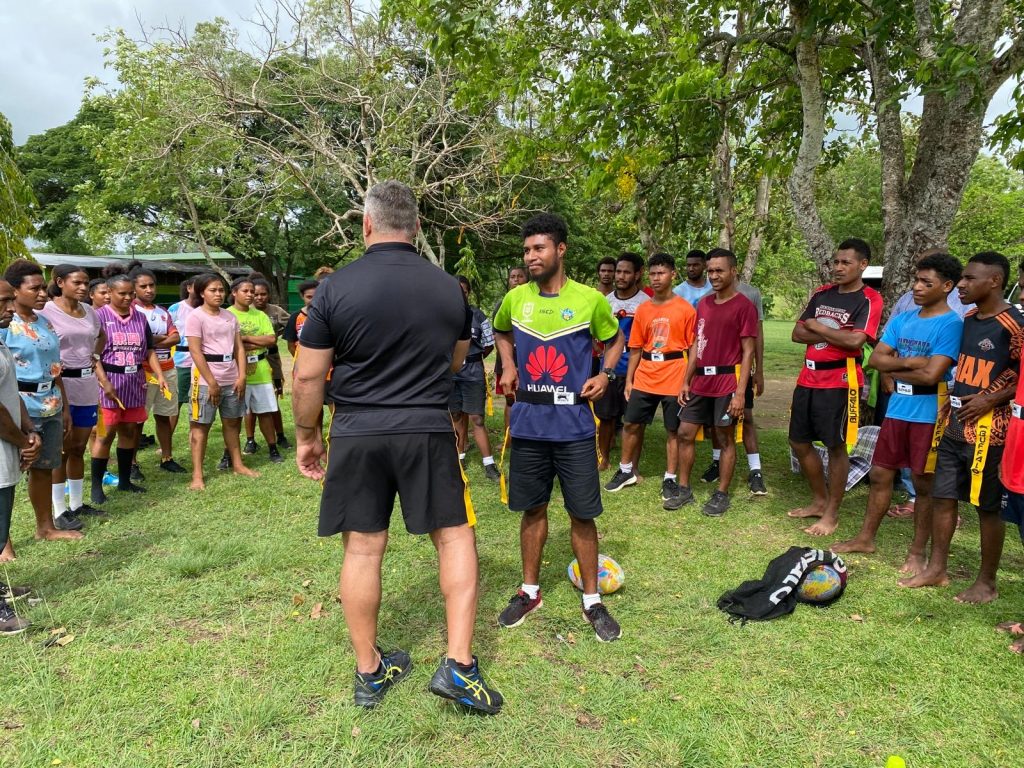
Welcome to Part 2 of our July 2026 Inspirational Interview with Tahina Booth, founder and Managing Director of Grass Skirt Project (GSP), a Papua New Guinea led organisation using sport to prevent gender-based violence and build gender equality.
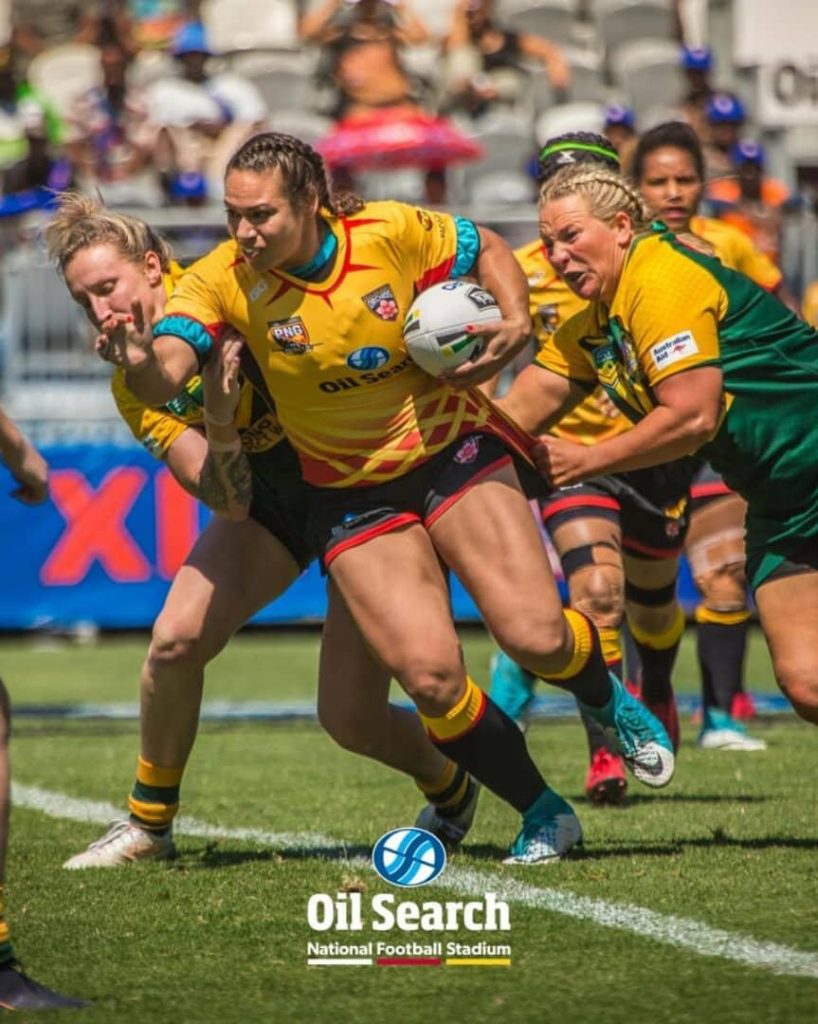
Born in Australia and raised in Papua New Guinea, Tahina is a former elite athlete who has represented Papua New Guinea in rugby league and Australia in Olympic weightlifting and powerlifting. She has spent more than a decade building community-led responses to violence. Through GymBox, GymBox Skools, 10 Million Strong, and the Hevea Cup, GSP works with people of all ages, schools, and private sector partners to restore the responsibility of keeping peace. In this part of the interview she talks about future plans for GSP and shares advice for other organisations seeking to use sport to help combat VAW.
Part one of Tahina’s interview was published 5 July 2026.
All photos are courtesy of Grass Skirt Project.
6. What advice would you give to activists and advocates in other countries who are keen to use the power of sport to tackle VAW in their part of the world?
Start by listening before you design anything.
Sport can open the door, but it is not the whole house. The real work is the conversation, relationships, safety, leadership, and local authority that sit around the sport. If you only run games, you will get participation. If you build the system around the games, you can create change.
Every culture has structures that already carry values of protection, responsibility, and belonging. In PNG, that includes kastom, elders, wantok systems, church, family, and school. The work is not to replace those structures with imported models. The work is to find the protective parts of those systems and strengthen them.
Do not rush trust. Do not introduce sensitive content before the room is safe enough to hold it. In our 10 Million Strong programme, we begin with belonging, team culture, and shared values before moving into violence, consent, power, and gender justice. That sequence matters.
And be careful with impact language. Do not claim more than you can prove. Measure what you can, be honest about what you are still learning, and remember that long-term cultural change is built through repeated practice, not one-off awareness events.
7. One of the keys to eradicating VAW is to get men and boys on board efforts to do so. What do you think are the most effective ways of galvanising men and boys to help to end VAW?
Men and boys respond when they are offered a role, not only a warning.
If the first message a boy hears is “you are the problem,” he will defend himself. But if the message is “you have a responsibility, you have strength, and your community needs you to use it differently,” then there is a way in.
In PNG, the strongest frame is not that men must become something foreign. It is that men must remember the responsibility they were always meant to carry. In tumbuna pasin, leadership was not supposed to mean domination. It was supposed to mean protection, service, restraint, and accountability to the collective.
Sport gives that lesson a physical language. A good pass. A controlled tackle. A teammate who protects the weaker player. A captain who stays calm under pressure. A young man who earns respect through service, not fear.
That is why we work with boys through training, teams, coaches, and peer leadership. We are not asking them to sit still and be lectured. We are asking them to practise a different kind of manhood until it becomes real.
8. Tell us about GSP’s plans for the future. What campaigns, programmes, or projects do you have coming up in the next 5 years?
Over the next five years, GSP is focused on scaling the school-based GymBox model and strengthening 10 Million Strong as a Pacific-led leadership and violence prevention programme.
Our immediate priority is to move from one GymBox Skools prototype at Badihagwa Technical Secondary School to a network of 10 to 12 school-based GymBox hubs across Port Moresby and NCD by 2030. Each hub would be anchored in a school, deliver 10 Million Strong, and connect education, health promotion, sport, safeguarding, youth leadership, gender-based violence prevention, and community use.
We are also building the evidence base. That includes stronger monitoring and evaluation, social return on investment, safeguarding systems, curriculum documentation, coach observations, student reflections, and measurement of belonging, self-efficacy, and bystander confidence.
In rugby league, we see a major opportunity to use the national visibility of the sport to support gender equality, girls’ safety, youth pathways, and community prevention. We are careful not to treat sport participation as the outcome. A girl standing on a field is not enough. The real question is: what keeps her there safely?
Longer term, 10 Million Strong is building toward a Pacific movement. The vision is a region where boys and men are not passive observers of gender equality, but active carriers of it.
9. How can The Pixel Project’s supporters engage with and support the efforts of GSP to stop VAW?
The first thing supporters can do is make the work visible. Follow Grass Skirt Project, share our stories, and help people understand that violence prevention in Papua New Guinea is not only about crisis response. It is also about building the conditions that stop violence from becoming normal in the first place.
The second thing is to fund the work. Support GymBox Skools, 10 Million Strong, and our school-based prevention model. We need partners who understand that safety, education, health, leadership, and sport are connected. Funding one piece without the others weakens the whole system.
The third thing is connection. If you work in philanthropy, sport, education, health, gender equality, or private sector investment, connect us with people who are serious about long-term Pacific-led change. If you are part of the Pacific diaspora, ask what your wantok responsibility looks like now. You do not have to be in Port Moresby to stand with this work.
There is a role for everyone. But the most useful support is not charity. It is partnership that respects PNG leadership, funds the real cost of prevention, and helps communities build systems that last.
10. In your considered opinion, how can we end VAW for good?
We end violence against women when communities decide that violence is incompatible with who they are.
Government, law, services, funding, and international frameworks matter. But the deepest shift happens when a community says: this is not us. This is not our kastom. This is not our pasin. This is not what our sons will become. This is not what our daughters will inherit.
There is no shortcut. There is only the work.
At Grass Skirt Project, we are trying to accelerate that moment of communal decision, one school, team, cohort, and young leader at a time. We honour tambu ties across generations, clans, and creation. We believe young people do not need to leave their culture behind to become safe, powerful, and free. They need the strongest parts of it returned to them.
That is our way of doing through pasin: the programme must be accountable to the people it serves. The evidence must return to the community. The partners must carry the canoe together. Young people must not be treated as beneficiaries only, but as future leaders who will carry the next cohort forward.
That is how we end violence. We rebuild the conditions that make care, respect, and accountability stronger than silence.