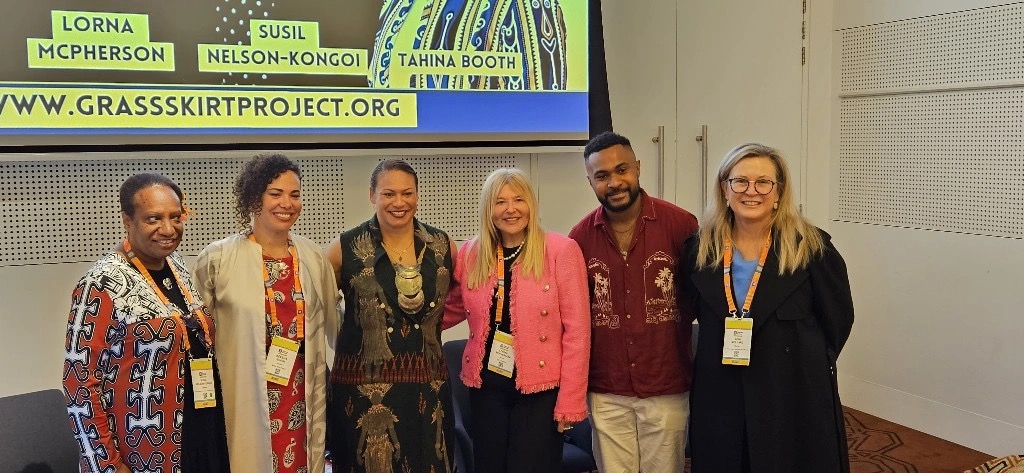
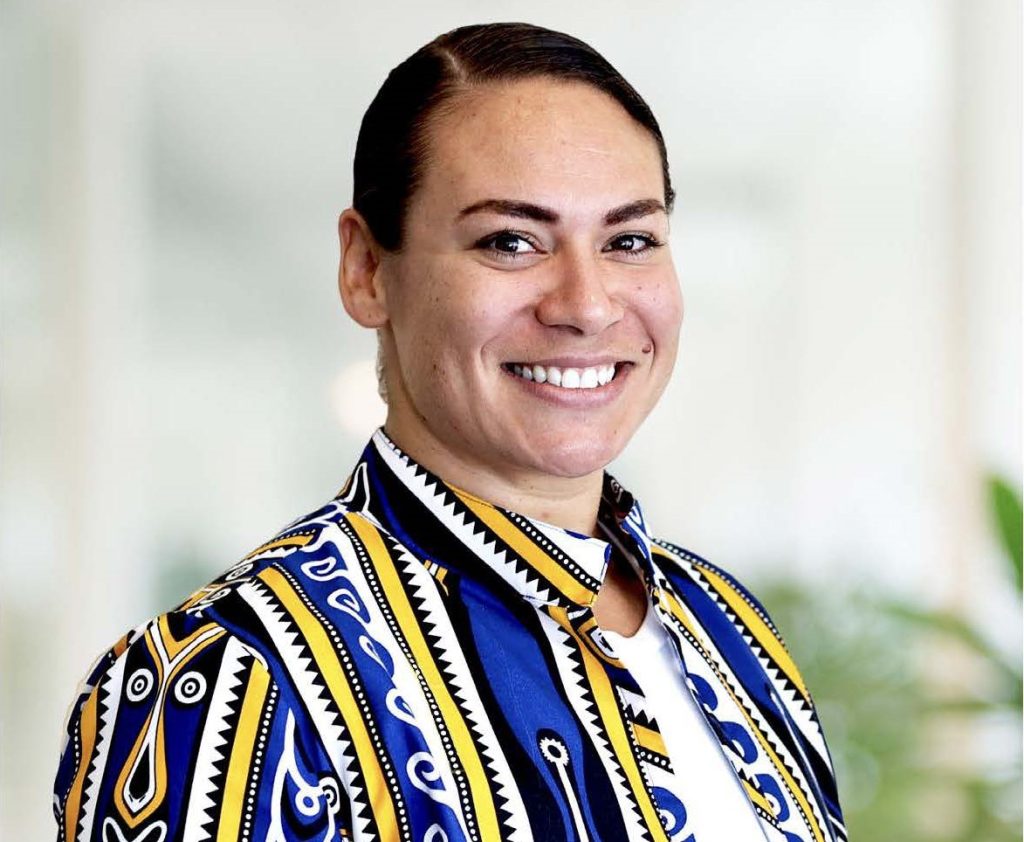
Welcome to Part 1 of our July 2026 Inspirational Interview with Tahina Booth, founder and Managing Director of Grass Skirt Project (GSP), a Papua New Guinea led organisation using sport to prevent gender-based violence and build gender equality.
Born in Australia and raised in Papua New Guinea, Tahina is a former elite athlete who has represented Papua New Guinea in rugby league and Australia in Olympic weightlifting and powerlifting. She has spent more than a decade building community-led responses to violence. Through GymBox, GymBox Skools, 10 Million Strong, and the Hevea Cup, GSP works with people of all ages, schools, and private sector partners to restore the responsibility of keeping peace.
Part two of Tahina’s interview will be published 6 July 2026.
All photos are courtesy of Grass Skirt Project.
1. How and why did you join the movement to end violence against women?
I was seven. My mother was six. We did not tell each other for twenty years. When I finally said the word out loud, she looked at me and said: me too.
That is what violence does when there is nowhere safe to take it. It moves quietly through families. It becomes normal. In Papua New Guinea (PNG), my story is not rare. Too many women and children carry violence and trauma in silence. Too many boys grow up without being taught another way to understand power.
I joined this movement because I could not accept that silence as our future. But I also knew that in PNG, we had to go where boys and men already were, where identity is formed, status is performed, and young people learn what it means to belong.
For me, that place was sport.
Sport gave me a language for discipline, courage, teamwork, and respect. It also gave me access to spaces where men and boys would actually show up. Grass Skirt Project was born from that understanding. We use sport because it is trusted and opens the door. The real work happens after that, in the conversations, relationships, repeated practice, and community responsibility that follows.
2. Grass Skirt Project (GSP) pioneers social change in Papua New Guinea by harnessing the unifying power of sports to address gender-based violence and promote equality. Could you tell us about how your organisation came to be founded and how it has developed over the years?
Grass Skirt Project (GSP) started from a simple observation: sport is one of the few places in Papua New Guinea where everyone shows up.
That was the opening.
At first, the work was informal. We used community sport to create conversations about respect, relationships, leadership, health, and violence. Over time, that grew into a more structured model.
GymBox began as a way to use boxing and fitness to build discipline, confidence, and character. Hevea Cup became a public mobilisation platform, showing that sport could be family-safe, women-led, and community-owned. 10 Million Strong developed into a leadership and violence prevention programme that works with young people through sport, emotional regulation, conflict resolution, bystander action, consent, and gender-just leadership.
The latest evolution is GymBox Skools. At Badihagwa Technical Secondary School, we are building Papua New Guinea’s first school-based GymBox model. It is not just a gym. It is social infrastructure. It connects education, health promotion, youth leadership, gender-based violence prevention, sport participation, safeguarding, and community use in one practical asset.
What has stayed the same from the beginning is the core logic: meet people where they already are, honour the community structures that already carry authority, and build the conditions for young people to practise a different future.
3. Could you tell us about the programmes and initiatives that GSP runs to tackle VAW and promote gender equality in Papua New Guinea?
GSP currently works through three connected platforms.
- GymBox and GymBox Skools use fitness and strength training to create trusted spaces for young people. Students train, move, learn, and build discipline, but the deeper work is about confidence, respect, emotional regulation, and belonging.
- 10 Million Strong is our youth leadership and violence prevention programme. It is delivered as a structured 12-week leadership season and grounded in PNG’s own education policy through the Stop Think Do conflict management model.
- Hevea Cup is our community rugby league and wellness platform. It gives GSP a public mobilisation space where women’s sport and gender equality messaging can be visible together. It shows the community what respectful culture looks like in practice.
Across all of this, sport is the meeting place. Pasin is the work. In Tok Pisin, pasin means more than behaviour. It is a way of being, relating, and carrying responsibility. When we talk about changing pasin, we are not shaming people but returning to the protective parts of who we are: respect, restraint, service, collective care, and accountability to family, clan, land, church, school, and community.
That is why our programmes are not delivered to communities. They are built with communities.
4. What are some of the particular challenges that GSP has faced and continues to face in the course of your work?
Papua New Guinea is one of the most culturally and geographically complex countries in the world. There are 850 languages and very different kastom systems. Communities range from urban to remote, with some inaccessible at times. What works in one does not automatically work in the others. That means the work cannot be copied and pasted. It has to be relational. It has to move at the speed of trust.
The second challenge is funding which often wants quick outcomes, but violence prevention is long-term work. We can measure progress, but we also have to be honest: changing norms and behaviour takes time.
The third challenge is sustainability. We want programs that can outlast a grant. That is why GymBox Skools matters. The school-based model is designed so the school can become the operator, GSP can retain and license the intellectual property, and community use can help build a local sustainability pathway over time.
The final challenge is safety. You cannot talk about violence without safeguarding. Young people need policies, but they also need trusted adults, trusted places, clear reporting pathways, community authority, and repeated practice. Safety cannot only be written in a document. It has to be lived every day.
5. Over the years, what sort of impact has GSP’s work had on stopping VAW in Papua New Guinea?
Culture changes slowly. What we see is movement: the language of respect and discipline being used more, conversations about violence taking place, young people seeing leadership not as control, but as responsibility.
In our current model, we are strengthening how we measure change. The 10 Million Strong programme now uses pre- and post-programme surveys, emotional check-ins, weekly reflection journals, facilitator reports, coach observations, and validated tools that look at self-efficacy, belonging, conflict response, and confidence to intervene safely.
Our forecast Social Return on Investment speaks to the relational governance at the heart of the model. It is not only measuring attendance or activity but also what happens when we invest in the relationships around a young person. In PNG, safety, leadership, and prevention are relational so governance has to be relational too.
That is why the number is not the story. The story is what the number reveals.
When we invest in the conditions around young people, the return is far greater than the cost. We are not just asking whether a boy attended a session but whether he can regulate anger, respect girls, intervene safely, work in a mixed-gender team, stay connected to school, and become a young leader his community can trust.