
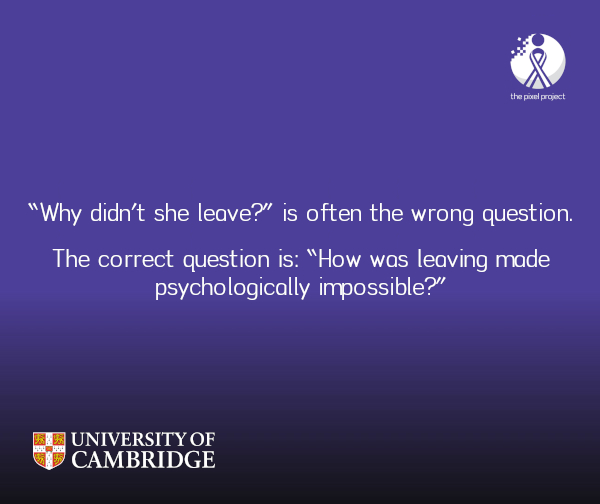
Perpetrators create and sustain domestic abuse through control, manipulation, and violence, which helps explain why victims make an  average of seven attempts to finally leave their abuser for good.  Barriers include lack of resources, lack of safety, and pervasive stigma. Yet the burden of leaving is still placed on the victim—especially women—who are repeatedly asked: ‘Why doesn’t she just leave?‘

University of Cambridge criminologists Mags Lesiak and Prof. Loraine Gelsthorpe’s groundbreaking research (Lesiak & Gelsthorpe University of Cambridge, 2025) demonstrates that some perpetrators deliberately create intense emotional bonds as a strategy of coercive control. Their study shows that even when victims are financially independent, live separately, and are not physically restrained, perpetrators may engineer attachment to confuse, entrap, and prevent leaving.

This mechanism is termed weaponised attachment: a form of manufactured emotional captivity created by the abuser, not a weakness or pathology in the victim.

Lesiak & Gelsthorpe’s research is the first of its kind.

As part of the general ongoing effort to eradicate victim-blaming, deepen general understanding about how abusers keep their victims entrapped, and improve frontline victim services, Mags Lesiak has partnered with The Pixel Project to disseminate the White paper on weaponised attachment to anti-violence against women organisations worldwide.

To aid in the adoption and practical application of Lesiak & Gelsthorpe’s research findings by domestic violence charities, nonprofits, NGOs, and frontline services across the world, The Pixel Project and Ms. Lesiak have developed a toolkit to accompany their White paper which includes a media kit and user guide.

As these research-based findings support wider efforts to combat victim-blaming, hold abusers accountable, and dispel toxic myths about domestic violence, we invite you to share feedback your organisation may have about the White Paper via our feedback form.

If you wish to show support for the White Paper, you can also become a recognised supporter with logos featured in the White Paper and related materials by filling in this form.


The White Paper

Introduction     Meet the Researchers     White Paper Toolkit PDF     White Paper Toolkit Word

The User Guide     The Media Kit     Share Your Feedback     Become a Recognised Supporter