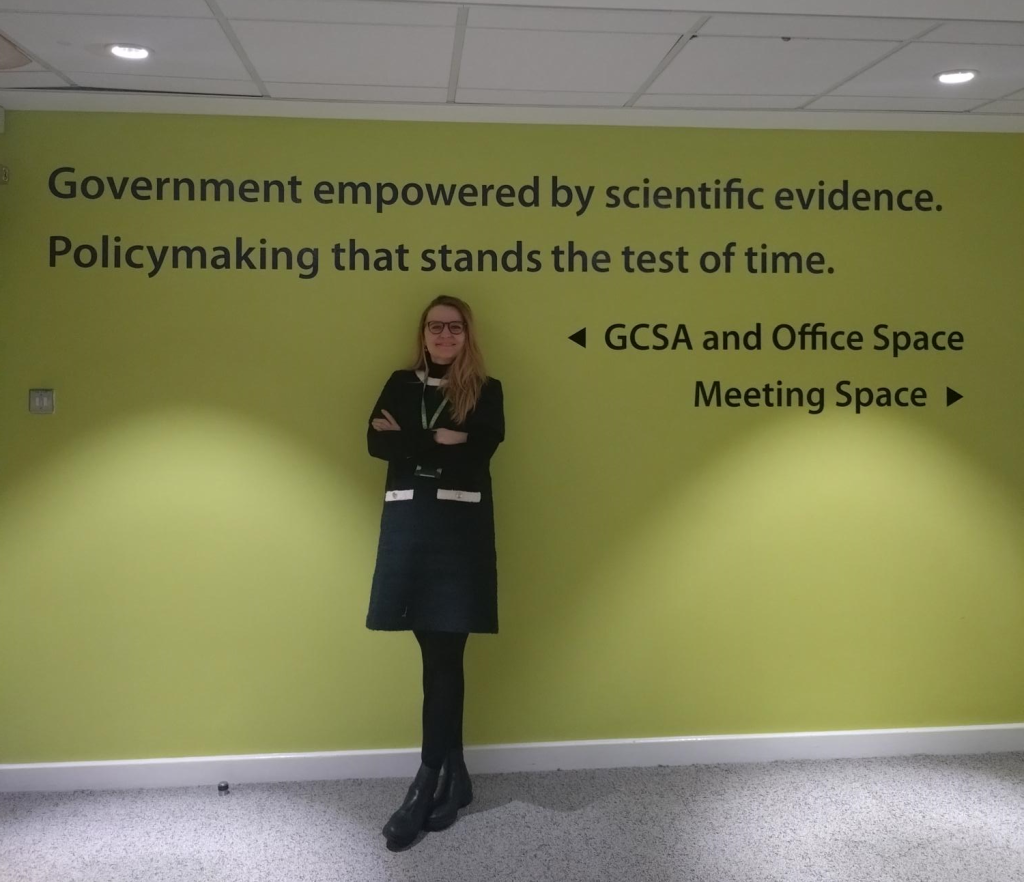
Welcome to Part 1 of our December 2025 Inspirational Interview with Mags Lesiak, criminologist and Cambridge Fellow at the UK Government Office for Science and Technology in the UK.
Mags is a psychological criminologist and Cambridge doctoral researcher working at the intersection of critical sociology, victimology, and machine learning. Her research examines how legal, clinical, and algorithmic systems interpret violence through the intertwined frameworks of risk, care, and control. She introduced the concept of weaponised attachment to describe how love can be used as a tool of control. Her work has been published in Violence Against Women, Teen Vogue, Psychology Today, ABC, Policing Insight, and the American Bar Association, and has informed UK government policy and international media coverage.
Part 2 of Mags’ interview will be published 8 December 2025.
All photos are courtesy of Mags Lesiak.
1.What inspired you to join the movement to end violence against women (VAW)?
Well, it happened through my frontline work with women experiencing abuse at the hands of their romantic partners. I saw survivors blamed or misunderstood, especially when their emotional attachment to the person harming them was misjudged as “weakness” or “codependency.” That experience made me realise the problem wasn’t women’s psychology, but the systems and cultural narratives that fail to recognise coercion, control, and systemic oppression. It motivated me to focus my research on giving survivors a voice.
2.Criminology is a vast interdisciplinary field of study that covers the breadth of human deviance and crime. Why did you decide to specialise in researching domestic violence?
I chose to specialise in domestic violence because it exposes the core mechanics of power, not just between individuals, but within entire systems. Working on the frontline, I saw that abuse was never just about anger or impulse; it was about control, entitlement, and social permission. Domestic violence sits at the intersection of psychology, law, culture, and gender. Studying it allowed me to interrogate how systems define harm and measure risk. For me, researching domestic violence isn’t simply about understanding crime; it’s about revealing how societies construct and sustain inequality through the language of care and control.
3.Aside from your criminology work in domestic violence research, you have also spent a decade working in frontline mental health and domestic violence services. How have your experiences in each role informed and influenced your overall approach to the fight to end VAW?
This experience really shaped the way I approach research and policy. I learned that theory means nothing if it can’t reach the women it’s supposed to protect. Working directly with survivors showed me how distress can be misread as dysfunction, and how language can erase the perpetrator and the reality of coercion. It’s why my research challenges not only perpetrators’ tactics, but also the frameworks of risk, care, and control. Both roles taught me the same lesson: ending violence against women requires changing the culture as much as the behaviour of abusers.
4.What are the particular challenges that criminologists face when conducting research on domestic violence and other forms of VAW?
Finding participants can be difficult; not everyone is ready to share their personal stories (and that’s ok). Also, many potential participants might face abuse if they speak up, and even when it’s safe, the emotional cost of revisiting those experiences can be immense. Epistemologically, the field itself presents challenges. Much of psychology is still built around models of rational choice, individual pathology, or static incident-based data, frameworks that don’t capture the relational, coercive, and structural dynamics of abuse. Patterns of control, degradation, and weaponised attachment don’t always lend themselves to measurement without distortion. I use numbers, but I also challenge what they can and can’t represent, because some truths about coercion are lived, and not always counted.
5. Your research aims to “inform evidence-based policies and interventions that promote safety for the victims and accountability for perpetrators”. This is crucial work because domestic violence victims in the UK and worldwide continue to experience being failed by law enforcement and the justice system, sometimes with fatal consequences. In your considered opinion, will there ever come a time when such policies and interventions can be implemented and carried out effectively by the police and courts?
To be honest, I’m far more hopeful than I used to be. After my piece for Policing Insight was published, it was warmly received by practitioners and policymakers alike, and I was genuinely surprised by how thoughtful, engaged, and open the responses were. It feels as though the sector is not only ready for change but actively asking for it, and wants to be part of the movement. Real progress, however, depends on cultural shifts together with procedural change; laws and policies alone won’t work unless the underlying attitudes also shift. Domestic violence must be understood as a pattern of power and control, not as victim pathology or private conflict; it’s structural, not individual. Ultimately, this is a societal issue, and ending it will require confronting the broader cultural norms that normalise coercion and gendered power.